News
What the Budget means for Uttlesford's farms
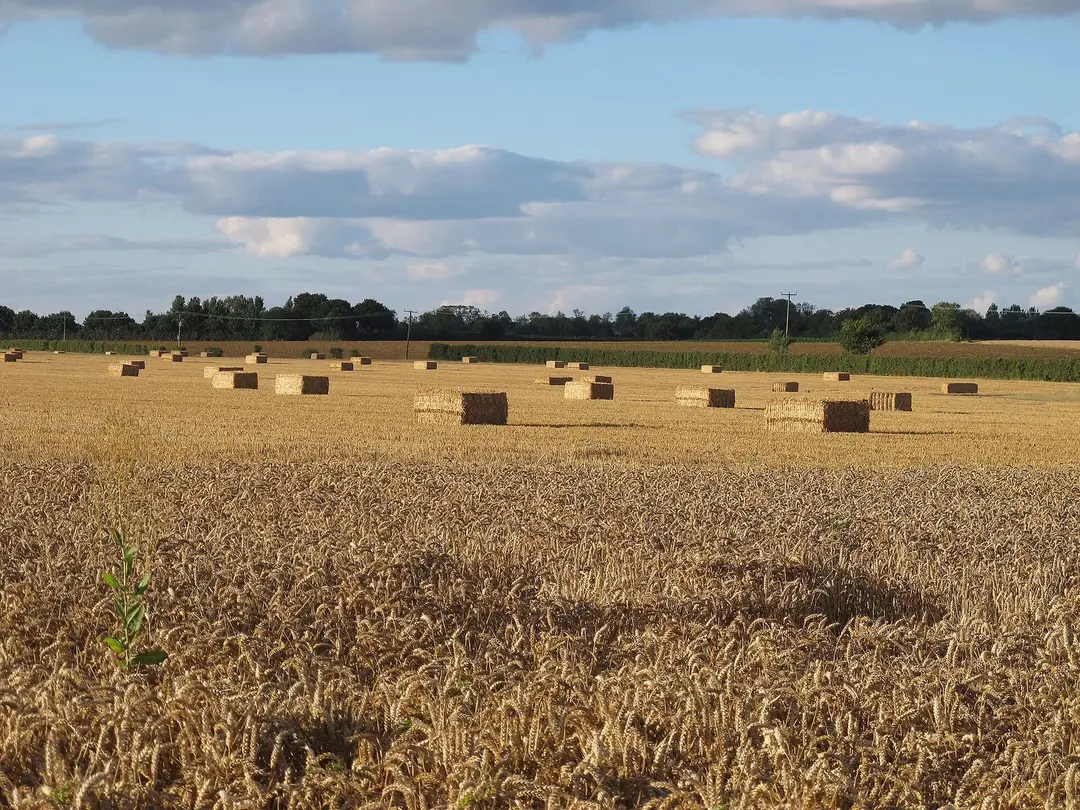
The Chancellor, John Healey, presented his first Budget today. For many farming families in Uttlesford, one question mattered most: would the Government change the inheritance tax rules for farms that came in this April? It didn’t: the rules below still apply. Here is what the rules are, what was said before the Budget, what the Budget changed, and what we still don’t know about the effect here.
Farming in Uttlesford
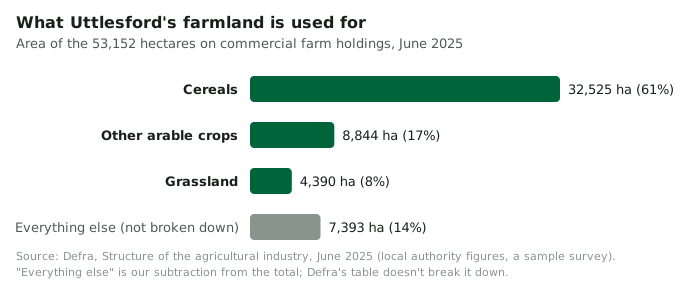
Uttlesford is a farming district. Defra’s latest figures, from its June 2025 survey, count 338 commercial farm holdings here, covering 53,152 hectares. Most of that land grows crops: 32,525 hectares of cereals and 8,844 hectares of other arable crops, about four-fifths of the total.1 The same survey counts 928 people working on those holdings, 584 of them farmers, partners, directors and their spouses.2
The rules since April
Inheritance tax is charged at 40% on the part of an estate above the tax-free threshold, which is usually £325,000. Two reliefs reduce the tax on farms and businesses: agricultural property relief (APR), for farmland, farm buildings and farmhouses, and business property relief (BPR), for business assets. Since 1992, both could give relief of up to 100%, with no upper limit.
That changed on 6 April 2026, under the Finance Act 2026:
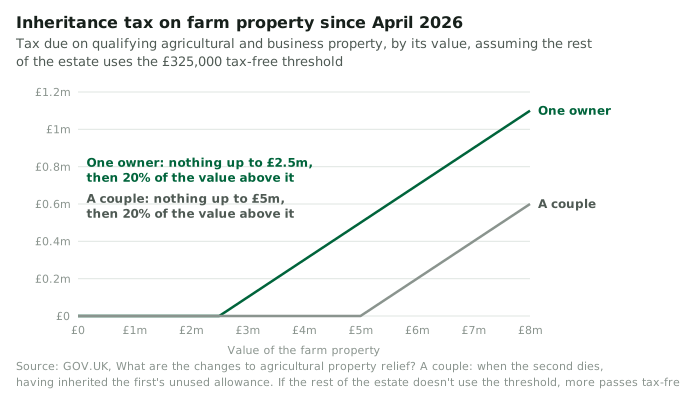
- A £2.5m allowance. 100% relief now covers only the first £2.5m of qualifying agricultural and business property, taken together. Above that, the relief is 50%, which the Government says means tax at “a reduced effective rate of up to 20%” on the excess, rather than 40%.
- Couples. Any unused allowance passes to a surviving spouse or civil partner, so the Government says a couple can pass on up to £5m of qualifying assets between them, or up to £5.65m once their two £325,000 tax-free thresholds are added. For a farm owned by one person, its figure is £2.825m.
- Paying. Tax due on qualifying property can be paid in equal yearly instalments over ten years, interest-free.
- Gifts. Farm or business property given away on or after 30 October 2024 counts against the allowance if the person who gave it dies within seven years.
- Inflation. The £2.5m stays fixed until April 2031, and after that rises each year with prices.
The Government first proposed a £1m allowance in the Autumn Budget 2024. On 23 December 2025 it raised it to £2.5m, saying it had “listened to concerns of the farming community and businesses”.
The Government’s figures
The Government estimates that, across the UK, up to 185 estates claiming APR (including those also claiming BPR) will pay more inheritance tax in 2026-27, and that about 85% of estates claiming APR will pay no more. Up to 1,100 estates in all will pay more, most of them claiming BPR alone. It expects the changes to APR and BPR together to raise £140m in 2026-27, and between £290m and £305m a year after that.3
Its reason for the change is that a few estates claimed most of the relief. In 2021-22, it says, 40% of the cost of APR went to the largest 7% of claims: 117 estates, which saved £219m in tax between them.
Two cautions. These figures count estates claiming relief in a single year, not farms. And farmers’ organisations don’t accept the picture: the president of the National Farmers’ Union (NFU), Tom Bradshaw, said in September that “some family farms still face substantial tax bills”. HM Revenue & Customs (HMRC) publishes no figures by district, so nobody outside it can say how many Uttlesford estates will pay more.
What was said before the Budget
The Government stood by the £2.5m allowance. A spokesperson said in September: “We listened to farmers and raised the relief threshold to £2.5 million”, “to protect smaller family farms and businesses while ensuring the largest estates make a fair contribution”. The Treasury said decisions on tax were “a matter for the chancellor to set out at fiscal events”.
But there were signs of movement. While campaigning in the Makerfield by-election, before he became Prime Minister, Andy Burnham said: “I personally have heard from farmers on family farms and I do think that needs looking at again.” In September the Mail on Sunday reported that the Government was considering reversing the change, or raising the allowance to £5m. The Government didn’t confirm either.
Farmers’ and landowners’ organisations asked for the change to be undone. The NFU wrote to the Chancellor on 23 September with a list of asks that included: “Remove changes to Agricultural Property Relief and Business Property Relief”. The president of the Country Land and Business Association (CLA), Gavin Lane, urged the Chancellor to use his first Budget for “fully reversing the inheritance tax changes”.
So did opposition parties. More than 100 Conservative MPs, members of the Scottish and Welsh parliaments and councillors wrote to the Prime Minister calling for “a full reversal” in this Budget. Kemi Badenoch, the Conservative leader and MP for North West Essex, pledged in November 2025 that scrapping the change would be the first thing a Conservative government would do. The Liberal Democrats called in March 2025 for the Government to “reverse this disastrous family farm tax”.
What the Budget changed
Nothing, for inheritance tax on farms. The Budget doesn’t mention agricultural or business property relief, and HMRC’s table of rates gives the 100% relief allowance as £2.5m for both this tax year and next, with the tax-free threshold still £325,000. The Budget’s changes to inheritance tax are about trusts and pensions, not farms. Neither option reported in September, reversing the change or raising the allowance to £5m, was taken up.
Some of the Budget’s other measures touch farm costs:
- Red diesel. The 3.7p-a-litre cut in duty on red diesel, the cheaper, rebated diesel farms can use in tractors and other machinery, now lasts until 30 June 2027. After that, the Government says, the duty will “return to its pre-March 2022 rate” and rise with inflation. HMRC’s table puts it at 11.65p a litre from 1 July 2027, up from 6.48p now.
- Fertiliser. Import tariffs on fertiliser are suspended from 26 November 2026 until the end of 2027, which the Government says will “lower production costs for the UK’s agricultural sector”.
- Fuel duty. The 5p cut in duty on road fuel now runs until 1 July 2027.
The Budget says nothing about the nature-friendly farming scheme (the Sustainable Farming Incentive) or Defra’s farming budget.
What it means here
The rules above stand. On the Government’s own examples, a farm owned by one person can pass on up to £2.825m of qualifying property without inheritance tax, and a couple up to £5.65m between them. Above that, the excess is taxed at an effective rate of up to 20%, which can be paid over ten years. Nobody outside HMRC can say how many Uttlesford farms are above those figures. From next July, a farm running machinery on red diesel will pay about 5p a litre more in duty than it does now.4
If you farm, or expect to inherit or pass on a farm, how the rules apply depends on how the farm is owned, let and run. HMRC’s guide, Agricultural Relief for Inheritance Tax, sets out which land and buildings qualify, and an accountant or solicitor can advise on your own circumstances. I’ll update this piece if the rules change.
Where Greens stand
Greens have said since the change was announced that “it is right to clamp down on those who buy farmland to avoid tax”, but that the Government also needs to “ensure that hard working farmers can earn a decent income”, as Emily O’Brien, then our spokesperson on food and farming, put it in November 2024. The Budget has left the rules as they are. I’d still like to see what Adrian Ramsay, then our co-leader, called a “clear distinction between people who are speculating in buying land and actual family farms”.
For most farms here, the bigger pressures are the prices they’re paid and the costs they face. In October, the Green Party conference backed “fair minimum farmgate prices” and “stronger powers for the Groceries Code Adjudicator”, the watchdog for how big supermarkets treat their suppliers. We also want farm support to reward nature-friendly farming, which protects our food security and lets wildlife recover.
Sources
HM Treasury
- Inheritance tax reliefs threshold to rise to £2.5m for farmers and businesses — press release, with Defra and the Department for Business and Trade, 23 December 2025.
- What are the changes to agricultural property relief? — explainer, with Defra, 5 November 2024 (updated 23 December 2025).
- Budget 2026 — the Budget report (HC 726), 28 October 2026.
HM Revenue & Customs
- How Inheritance Tax works: thresholds, rules and allowances — guide, undated.
- Agricultural Relief for Inheritance Tax — guidance, updated 6 April 2026.
- Agricultural property relief and business property relief changes — tax information and impact note, 26 November 2025 (updated 3 March 2026).
- Budget 2026: Overview of tax legislation and rates, Annex A: rates and allowances — rates table, 28 October 2026.
Department for Environment, Food & Rural Affairs
- Structure of the agricultural industry in England and the UK at June — statistics, local authority results for June 2025 (updated April 2026).
legislation.gov.uk
- Finance Act 2026, Schedule 12: Reform of reliefs for business property and agricultural property — Act of Parliament, Royal Assent 18 March 2026.
National Farmers’ Union
- NFU’s road to the Budget 2026 – timeline of our work — web page, 7 October 2026 (updated 26 October 2026).
Liberal Democrats
- Farmers protest: Govt must reverse “disastrous family farm tax” to do what is best for the future of the country — press release, 3 March 2025.
Farmers Weekly
- Conservatives demand urgent IHT reversal ahead of Budget — news report, 17 November 2025.
- Pressure mounts on Burnham for Budget farm tax U-turn — news report, 4 September 2026.
Farmers Guide
- Government reportedly considering farm inheritance tax U-turn — news report, 24 September 2026.
- What is farming industry calling for in Autumn Budget 2026? — news report, 26 October 2026.
Business Matters
- Farmers to Burnham: you said the family farm tax ‘needs looking at again’ — news report, 21 July 2026.
Green Party
- Farmers are feeling abandoned, but taxing wealth is right, say Greens — press release, 18 November 2024.
- Green Party conference backs action to make food more affordable and strengthen UK food security — press release, 3 October 2026.
PoliticsHome
- Greens Urge Government To Rethink Tax On Farming — Sophie Church, 17 November 2024.
Footnotes
-
32,525 + 8,844 = 41,369 hectares, ~78% of 53,152: our arithmetic from Defra’s table. Of the remaining 11,783 hectares, 4,390 are grassland; this table doesn’t say what the rest is. ↩
-
The figures are for commercial holdings only, as Defra defines them (for example, more than 5 hectares of farmland, or more than 10 cattle). They come from a sample survey, so they are estimates. 584 is our sum of Defra’s 313 full-time and 271 part-time farmers, partners, directors and spouses. ↩
-
The Government’s figures, certified by the Office for Budget Responsibility, for all the APR and BPR changes together, including the lower relief on some shares and the £2.5m allowance. They are £140m in 2026-27, £290m in 2027-28, £305m in 2028-29 and £295m in each of 2029-30 and 2030-31. ↩
-
11.65p − 6.48p = 5.17p a litre: our arithmetic from HMRC’s table. ↩