
News
What the Budget means for SEND in Essex

Today’s Budget settled one big question about how support for children and young people with special educational needs and disabilities (SEND) is paid for in England, and left another open. Here is what it means for Essex County Council (ECC), which runs SEND services for families in Uttlesford.
The deficits
Councils get money from the Department for Education (DfE) to support children and young people with high needs, including those with education, health and care (EHC) plans. When a council spends more than that, the gap builds up as a deficit. An accounting rule, the “statutory override”, keeps these deficits separate from councils’ main budgets for now.
What the Budget says
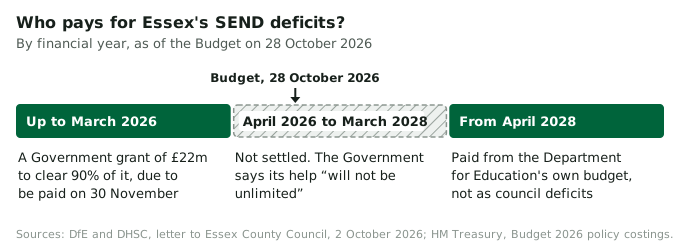
The Budget’s policy costings say that “from [financial year] 28-29 onwards the Statutory Override will end and all pressure from the SEND system will be funded within DfE DEL [Departmental Expenditure Limit]1 rather than through LA [local authority] deficits”. In plain terms: from April 2028, the extra costs of SEND are to be met from the Department for Education’s own budget, instead of building up as deficits on councils’ books.
The only other SEND measure is a net adjustment to high needs funding for 2026-27 and 2027-28: extra money for staff pay, less a cut that reflects lower teachers’ pension costs. The Budget report mentions high needs funding only in its table of measures. It has no other new money for SEND.
What it means for Essex
On 2 October the Government approved Essex’s SEND reform plan. With it came a grant of £22,044,709, to clear 90% of the deficit ECC had built up by the end of March 2026, “with payments expected on 30 November 2026”.
What the Budget doesn’t say is what happens to the deficits councils build up this year and next, before the override ends. The Government’s approval letter told ECC that its approach to deficits in 2026/27 and 2027/28 “will not be unlimited”. The Budget adds nothing to that.
None of this changes who decides support for children here. Assessments, EHC plans, school places and SEND transport are still ECC’s responsibility.
If you’re a parent or carer with questions about your child’s support, Essex’s SEND Information, Advice and Support Service (Essex SENDIASS) can help. It gives “free, confidential and impartial information, advice and support” about SEND to parents and carers, and to children and young people up to 25. Its helpline is 01245 204338 (Monday, Tuesday and Thursday, 10am to 2pm), or you can email [email protected].
Sources
HM Treasury
- Budget 2026 — the Budget report (HC 726), 28 October 2026.
- Budget 2026: Policy costings — supporting document, 28 October 2026.
Department for Education and Department of Health and Social Care
- Local SEND Reform Plan Assessment Outcome — letter to ECC and NHS Essex ICB, 2 October 2026.
Essex SENDIASS
- Essex SEND IASS — home page.
- Contact us — web page.
Footnotes
-
A Departmental Expenditure Limit is the spending budget the Treasury sets for a government department, usually for several years at a time at a spending review. ↩